Tuesday, 26 December 2017

Rectangle


rectangle is a shape with four sides and four corners. The corners are all right angles. It follows that the lengths of the pairs of sides opposite each other must be equal.
People make many rectangular things, including most tables, boxes, books, and papers.
A rectangle with all four sides equal in length is called a square.
Image result for rectangle
PROPERTIES OF RECTANGLE:
  1. The opposite sides are equal.
  2. All angles are equal.
  3. Each angle is a right angle.
  4. The diagonals are equal in length.
  5. The diagonals bisect each other.
FORMULAS OF RECTANGLE:
 Area of Rectangle=length*breadth
                              =l*b sq.units.
Perimeter of Rectangle=2(l+b) units.

Monday, 18 December 2017

Square


square is a shape with four equal sides and four corners that are all right angles (90 degrees). The diagonals of a square also cross at right angles. The angle between any diagonal and a side of a square is 45 degrees. A square has rotational symmetry of four. It has four lines of regular symmetry.
A square is a type of rectangle with all sides of equal length. However note that while a square is a type of rectangle, a rectangle does not necessarily need to be a square.

A square is also the 2-dimensional analogue of a cube.

Image result for square

PROPERTIES OF SQUARE:
  1. All the angles are equal.                                                                    
  2. All the sides are of equal length.
  3. Each of the angle is a right angle.
  4. The diagonal are of equal length and breadth.
  5. The diagonals bisect each other at right angles.
FORMULAS:
  Area of square=side*side
                       A=a*a 
                         =a2 sq.units
 Perimeter of square=4a units

Sunday, 10 December 2017

Circle


circle is a roundtwo-dimensional shape. All points on the edge of the circle are at the same distance from the centre.
The radius of a circle is a line from the centre of the circle to a point on the side. Mathematicians use the letter r for the length of a circle's radius. The centre of a circle is the point in the very middle.
The diameter (meaning "all the way across") of a circle is a straight line that goes from one side to the opposite and right through the centre of the circle. Mathematicians use the letter d for the length of this line. The diameter of a circle is equal to twice its radius (d equals 2 times r).
The circumference (meaning "all the way around") of a circle is the line that goes around the centre of the circle. Mathematicians use the letter C for the length of this line.
The number π (written as the Greek letter pi) is a very useful number. It is the length of the circumference divided by the length of the diameter (π equals C divided by d). As a fraction the number π is equal to about 227 or 335/113 (which is closer) and as a number it is about 3.1415926535.
Circle Area.svg
The areaa, inside a circle is equal to the radius multiplied by itself, then multiplied by π (a equals π times r times r).

Calculating π

π can be measured by drawing a large circle, then measuring its diameter (d) and circumference (C). This is because the circumference of a circle is always π times its diameter.
π can also be calculated by only using mathematical methods. Most methods used for calculating the value of π have desirable mathematical properties. However, they are hard to understand without knowing trigonometry and calculus. However, some methods are quite simple, such as this form of the Gregory-Leibniz series:
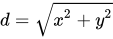
While that series is easy to write and calculate, it is not easy to see why it equals π. An easier to understand approach is to draw an imaginary circle of radius r centered at the origin. Then any point (x,y) whose distance d from the origin is less than r, calculated by the pythagorean theorem, will be inside the circle:
Finding a set of points inside the circle allows the circle's area A to be estimated. For example, by using integer coordinates for a big r. Since the area A of a circle is π times the radius squared, π can be approximated by using:
REFERENCE FROM WIKIPEDIA

Friday, 1 December 2017

Shapes


shape is a geometric figure that can be described with mathematics. One way to classify shapes is to describe a bigger kind of shape that the shape is one of. For example, they can be classified by their different numbers of dimensions. Thus, circles are two-dimensional shapes so, like other 2D shapes, they will fit into a flat plane.
Three-dimensional objects like cubes will not fit inside a plane, because they are not flat. Four-dimensional shapes made of polygons are called polychorons, and shapes made of polygons of any dimension are polytopes.
Two shapes are said to be equal, if one can be changed into the other by turning, moving, growing, shrinking, or more than one of these in combination.
2D SHAPES:
These are two-dimensional shapes or flat plane geometry shapes. Their sides are made of straight or curved lines. They can have any number of sides. Plane figures made of lines are called polygons. Triangles and squares are examples of polygons.
3D SHAPES:
These are three-dimensional shapes. Their sides are made of flat or curved surfaces.
REFERENCE FROM WIKIPEDIA

Monday, 20 November 2017

Three dimension shapes


The shapes which can be measured in 3 directions are called three-dimensional shapes. These shapes are also called solid shapes. Length, width, and height (or depth or thickness) are the three measurements of the three-dimensional shapes. They are different from 2D shapes because they have thickness. A number of examples can be found in everyday life. Some of them are:
Dimensional - Three Dimensional Shapes
Three Dimensional Shapes
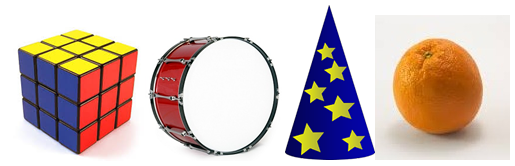
The Rubik’s Cube is an example of a cube, the drum is a cylinder, the birthday cap is a cone and the orange is a sphere.

Faces, Edges and Vertices

Three-dimensional shapes have many attributes such as faces, edges and vertices. The flat surfaces of the 3D shapes are called the faces. The line segment where two faces meet is called an edge. A vertex is a point where 3 edges meet.
Dimensional - Three Dimensional Shapes
Let us consider a few shapes to learn about them.

Cube

Dimensional - Three Dimensional Shapes
  • All edges are equal
  • 8 vertices
  • 12 edges
  • 6 faces.

Cuboid

Dimensional - Three Dimensional Shapes
  • 8 vertices
  • 12 edges
  • 6 faces

Prism

Dimensional - Three Dimensional Shapes
  • 6 vertices
  • 9 edges
  • 5 faces – 2 triangles and 3 rectangles

Square Pyramid

Dimensional - Three Dimensional Shapes
  • 5 vertices
  • 8 edges
  • 5 faces

Cylinder

Dimensional - Three Dimensional Shapes
  • No vertex
  • 2 edges
  • 2 flat faces – circles
  • 1 curved face

Cone

Dimensional - Three Dimensional Shapes
  • 1 vertex
  • 1 edge
  • 1 flat face – circle
  • 1 curved face

Sphere

Dimensional - Three Dimensional Shapes
  • No vertex
  • No edges
  • 1 curved face

  • REFERENCE FROM   https://byjus.com/maths/three-dimensional-shapes/

Sunday, 12 November 2017

Polygon


Definition of a Polygon

polygon is any 2-dimensional shape formed with straight lines. Triangles, quadrilaterals, pentagons, and hexagons are all examples of polygons. The name tells you how many sides the shape has. For example, a triangle has three sides, and a quadrilateral has four sides. So, any shape that can be drawn by connecting three straight lines is called a triangle, and any shape that can be drawn by connecting four straight lines is called a quadrilateral.
Polygons
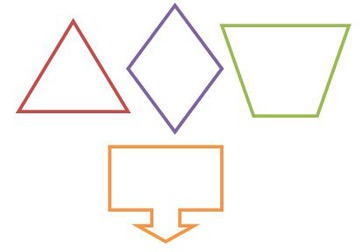
polygon
All of these shapes are polygons. Notice how all the shapes are drawn with only straight lines? This is what makes a polygon. If the shape had curves or didn't fully connect, then it can't be called a polygon. The orange shape is still a polygon even if it looks like it has an arrow. All the sides are straight, and they all connect. The orange shape has 11 sides.
I've mentioned a few polygons and have shown you a few common shapes. Here is a list of those in addition to several more:
Shape# of Sides
Triangle3
Square4
Rectangle4
Quadrilateral4
Pentagon5
Hexagon6
Heptagon7
Octagon8
Nonagon9
Decagon10
n-gonn sides
The last entry includes the general term for a polygon with n number of sides. Polygons aren't limited to the common ones we know but can get pretty complex and have as many sides as are needed. They can have 4 sides, 44 sides, or even 444 sides. The names would be 4-gon, or quadrilateral, 44-gon, and 444-gon, respectively. An 11-sided shape can be called an 11-gon.

Regular Polygons

A special class of polygon exists; it happens for polygons whose sides are all the same length and whose angles are all the same. When this happens, the polygons are called regular polygons. A stop sign is an example of a regular polygon with eight sides. All the sides are the same and no matter how you lay it down, it will look the same. You wouldn't be able to tell which way was up because all the sides are the same and all the angles are the same.
When a triangle has all the sides and angles the same, we know it as an equilateral triangle, or a regular triangle. A quadrilateral with all sides and angles the same is known as a square, or regular quadrilateral. A pentagon with all sides and angles the same is called a regular pentagon. An n-gon with sides and angles the same is called a regular n-gon.
Regular polygons
polygon
Here is a regular triangle, a regular quadrilateral, and a regular pentagon. Do you see how all the sides are the same and no matter how you flip it, it will look the same?

Angles of Regular Polygons

Regular polygons also have two different angles related to them. The first is called the exterior angle, and it is the measurement between the shape and each line segment when you stretch it out past the shape.
REFERENCE FROM  https://study.com/academy/lesson/what-is-a-polygon-definition-shapes-angles.html

Saturday, 4 November 2017

Geometrical shapes


geometric shape is the geometric information which remains when locationscaleorientation and reflection are removed from the description of a geometric object.[1] That is, the result of moving a shape around, enlarging it, rotating it, or reflecting it in a mirror is the same shape as the original, and not a distinct shape.
Objects that have the same shape as each other are said to be similar. If they also have the same scale as each other, they are said to be congruent.
Many two-dimensional geometric shapes can be defined by a set of points or vertices and lines connecting the points in a closed chain, as well as the resulting interior points. Such shapes are called polygons and include trianglessquares, and pentagons. Other shapes may be bounded by curves such as the circle or the ellipse.
Many three-dimensional geometric shapes can be defined by a set of vertices, lines connecting the vertices, and two-dimensional facesenclosed by those lines, as well as the resulting interior points. Such shapes are called polyhedrons and include cubes as well as pyramids such as tetrahedrons. Other three-dimensional shapes may be bounded by curved surfaces, such as the ellipsoid and the sphere.
A shape is said to be convex if all of the points on a line segment between any two of its points are also part of the shape.
REFERENCE FROM WIKIPEDIA